Evolve Resource
Business Systems: Types, Process, & Examples
Every thriving company, from a two-person startup to a Fortune 500 enterprise, runs on business systems. These invisible frameworks quietly power every transaction, communication, decision, and delivery that happens inside an organization. Yet, for many business owners and managers, the concept of a ‘business system’ remains abstract, misunderstood, or simply overlooked.
Modern organizations rely heavily on Business Systems to maintain operational efficiency, reduce manual work, and support long-term growth. Running a successful company requires more than just a great idea or a talented team. Businesses grow and operate efficiently when their daily operations follow clear structures, repeatable workflows, and organized processes. This is where Business Systems play a critical role.
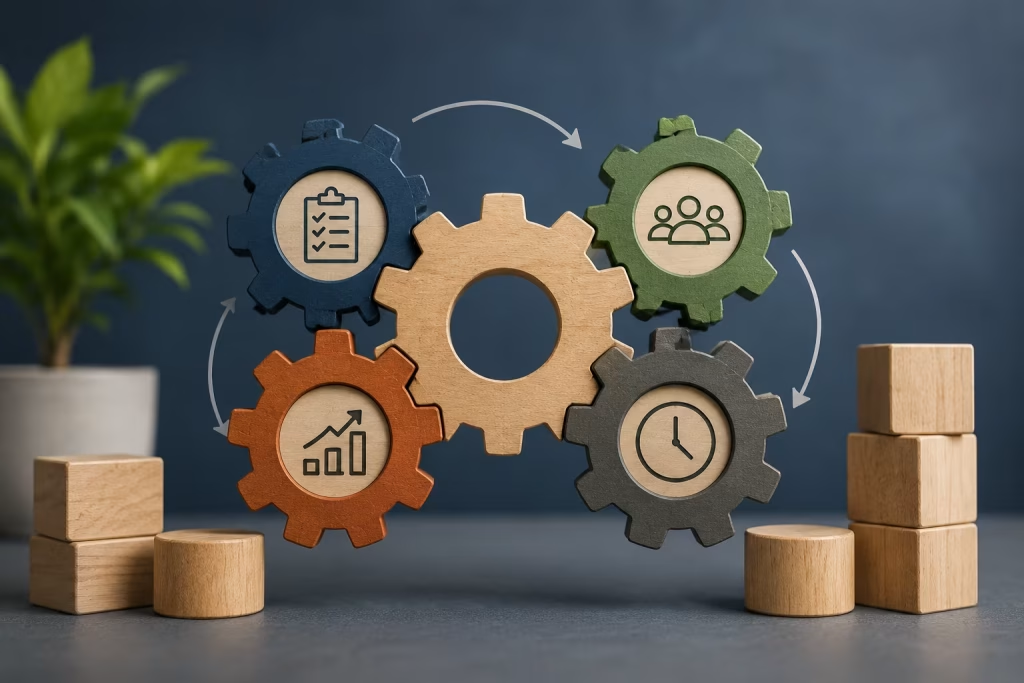
What Are Business Systems?
Business Systems refer to structured processes, tools, technologies, and procedures that organizations use to manage and coordinate their operations. These systems ensure that tasks are performed consistently and efficiently across different departments.
A Business System connects people, processes, and technology to achieve business objectives. It organizes workflows so employees know exactly how tasks should be completed and how information should move within the organization.
Business Systems support organizations by:
- Standardizing daily operations
- Improving efficiency and productivity
- Reducing errors and duplication of work
- Enhancing communication across departments
- Supporting data-driven decision-making
Without structured systems, businesses often experience confusion, inefficiency, and operational delays.
Why Are Business Systems Important?
Business systems are the backbone of successful organizations. Without them, companies often face chaos, inefficiency, and inconsistent outcomes.
- Enhanced Efficiency: Streamlined processes reduce wasted time and resources.
- Improved Decision-Making: Systems provide consistent data and insights for strategic choices.
- Scalability: Repeatable processes make it easier to grow the business without breaking operations.
- Accountability: Clear systems define responsibilities and expectations for every team member.
Organizations that ignore building proper systems often struggle to maintain performance as they scale.
What Are The Components Of A Business System?
Every business system, regardless of industry or size, is made up of five fundamental components:
1. People
The individuals who perform tasks, make decisions, and interact within the system. This includes employees, managers, vendors, and even customers in some cases.
2. Processes
The sequence of steps or activities that must be completed to achieve the desired outcome. Processes define the ‘how’ of a system.
3. Tools & Technology
The software platforms, physical equipment, communication tools, and automation systems that enable the process to function efficiently.
4. Information & Data
The inputs, outputs, reports, and feedback loops that keep the system informed and allow for continuous improvement.
5. Rules & Policies
The guidelines, standards, and compliance frameworks that govern how the system operates and ensure consistency.
What Is the Business System Process?
Every business system follows a structured process to ensure repeatability and efficiency.
A typical business system process involves:
- Define Objectives: Identify the desired outcome of the system (e.g., faster order processing or improved customer retention).
- Map the Process: Document each step required to achieve the objectives, including inputs, actions, and outputs.
- Implement Tools and Resources: Select the software, team members, and workflows necessary to execute the system effectively.
- Train Teams: Ensure all employees understand their roles and responsibilities within the system.
- Monitor Performance: Measure KPIs and assess if the system is achieving its goals.
- Refine and Optimize: Continuously improve processes based on feedback, data, and evolving business needs.
Following this structured process ensures that business systems deliver consistent, high-quality results.
What Are the Main Types of Business Systems?
Business systems can be categorized in multiple ways, by function, by technology, by industry, or by organizational level. The most practical framework for understanding business system types divides them into functional categories aligned with the key areas of business operations.
Below is a detailed breakdown of the primary types of business systems, along with their purpose, components, and real-world relevance.
1. Operations Management Systems
Operations management systems govern the day-to-day production and delivery of goods or services. These systems ensure that a business can consistently deliver its core value proposition at the right quality, in the right quantity, and at the right time.
Functions include production planning, quality control, inventory management, supply chain coordination, and facilities management. In manufacturing, an operations system might include automated assembly lines, quality assurance checkpoints, and vendor management protocols. In a service business, it might cover service delivery workflows, scheduling systems, and customer fulfillment processes.
- Production planning and scheduling
- Inventory and supply chain management
- Quality assurance and control processes
- Facilities and resource management
- Vendor and supplier relationship management
2. Financial Management Systems
Financial management systems oversee the flow of money into, within, and out of an organization. These systems ensure financial accuracy, regulatory compliance, strategic resource allocation, and long-term fiscal health.
A robust financial business system includes accounts payable and receivable, payroll processing, budgeting and forecasting, tax compliance, and financial reporting. Modern financial systems are typically powered by enterprise resource planning (ERP) software such as SAP, Oracle, or QuickBooks. Effective financial systems also work alongside sound business spend management practices to help organizations monitor spending and allocate resources responsibly.
- Accounts payable and receivable management
- Payroll and compensation administration
- Budgeting, forecasting, and cash flow management
- Tax planning and regulatory compliance
- Financial reporting and audit management
3. Human Resources (HR) Management Systems
HR business systems manage the entire employee lifecycle, from recruitment and hiring to performance management, compensation, training, and eventual offboarding. These systems are critical for building a capable, engaged, and legally compliant workforce.
Modern human resources management systems (HRMS) or human capital management (HCM) platforms such as Workday, BambooHR, or ADP, automate many HR functions and provide data-driven insights into workforce performance, retention, and talent development.
- Talent acquisition and recruitment workflows
- Employee onboarding and orientation programs
- Performance management and evaluation cycles
- Learning, development, and training management
- Compensation, benefits, and payroll administration
- Employee relations and compliance tracking
4. Sales and Customer Relationship Management Systems
Sales and CRM systems manage the entire customer journey, from first contact and lead nurturing through to closing, onboarding, and long-term retention. These business systems are the primary revenue engines of any customer-facing organization.
CRM platforms such as Salesforce, HubSpot, and Zoho CRM serve as the technological backbone of sales systems, centralizing customer data, automating follow-ups, tracking deal pipelines, and generating revenue forecasts. A well-designed sales system ensures that no lead falls through the cracks and that every customer interaction is informed, timely, and personalized.
- Lead generation and prospect qualification
- Sales pipeline management and forecasting
- Customer onboarding and success management
- Upsell, cross-sell, and retention workflows
- Customer support and helpdesk processes
5. Marketing Systems
Marketing business systems govern how a company attracts, engages, and converts its target audience. These systems encompass content creation workflows, campaign management, brand governance, SEO and digital marketing processes, email marketing automation, social media management, and analytics tracking.
Marketing systems bridge the gap between strategic brand positioning and tactical lead generation. They ensure consistent messaging across all channels, enable data-driven campaign optimization, and provide clear attribution for marketing spend.
- Brand management and messaging frameworks
- Content creation and editorial calendars
- Digital marketing and SEO workflows
- Email marketing and automation sequences
- Social media and community management
- Analytics, reporting, and performance optimization
6. Information Technology (IT) Systems
IT business systems provide the technological infrastructure that all other systems depend on. This includes network management, cybersecurity, software deployment, data storage, hardware maintenance, help desk support, and IT governance.
In the modern digital business environment, IT systems are no longer a back-office function, they are a core strategic asset. The reliability, security, and scalability of an organization’s IT infrastructure directly affects its ability to operate, innovate, and compete.
- Network infrastructure and telecommunications management
- Cybersecurity and data protection frameworks
- Software development and deployment pipelines
- Data management, storage, and backup systems
- IT help desk and user support workflows
7. Customer Service Systems
Customer service business systems define how an organization responds to customer inquiries, resolves complaints, manages returns and refunds, and builds long-term customer loyalty. These systems are increasingly critical as customers demand faster, more personalized, and more consistent service experiences.
Effective customer service systems leverage tools such as Zendesk, Freshdesk, or Intercom, combined with clearly defined escalation protocols, service level agreements (SLAs), and feedback mechanisms.
8. Supply Chain and Procurement Systems
Supply chain and procurement systems manage the sourcing, purchasing, and delivery of goods and materials required to run the business. These systems encompass supplier selection and evaluation, purchase order management, contract management, logistics coordination, and inventory replenishment.
Supply chain systems became particularly critical following global supply chain disruptions in 2020-2022, prompting organizations worldwide to invest heavily in supply chain visibility, redundancy, and risk management capabilities.
How Does a Business System Differ from a Business Process?
Understanding the difference between a Business System and a Business Process is important for improving how an organization operates. While both concepts work together to support business efficiency, they serve different roles within a company’s structure and operations.
Aspect | Business System | Business Process |
Definition | A Business System is a structured framework of tools, policies, technologies, and procedures used to manage and support overall business operations. | A Business Process is a specific sequence of tasks or activities performed to complete a particular business objective. |
Purpose | The purpose of a Business System is to organize and manage multiple processes to ensure smooth business performance. | The purpose of a Business Process is to accomplish a single operational task or workflow efficiently. |
Scope | A Business System has a broader scope and includes many processes, technologies, and operational strategies. | A Business Process has a narrower scope and focuses on a single workflow or activity. |
Structure | A Business System integrates people, software, policies, and processes to support the entire organization. | A Business Process focuses mainly on the step-by-step actions required to complete a task. |
Example | A Customer Relationship Management (CRM) platform combined with sales procedures and reporting tools is part of a Business System. | The steps involved in handling a customer inquiry or processing an order represent a Business Process. |
Relationship | A Business System contains and manages multiple business processes. | A Business Process operates within a business system to achieve specific outcomes. |
What Are the Best Real-World Examples of Business
Systems?
Theory is valuable, but real-world examples make business systems tangible and actionable. The following examples demonstrate how world-class organizations have built specific business systems that drive extraordinary results. These are not abstract frameworks; they are battle-tested operational architectures that you can study, adapt, and apply to your own organization.
Example 1: Amazon’s Fulfillment and Logistics System
Amazon’s fulfillment system is one of the most sophisticated consumer logistics business systems ever built. Its core objective is simple but ambitious: deliver the right product to the right customer in the shortest time at the lowest cost.
Key features of Amazon’s system include:
- Predictive inventory algorithms to pre-position products in warehouses near anticipated demand.
- Automated picking and packing using Kiva robots in fulfillment centers.
- Dynamic delivery routing optimization for efficiency.
- Real-time order tracking accessible to customers.
- Sophisticated returns and refunds processing workflows.
Example 2: McDonald’s Operations and Quality Control System
McDonald’s is frequently cited in management literature as a textbook example of effective business systems. Serving over 69 million customers daily across more than 100 countries, McDonald’s achieves remarkable consistency through its operational systems.
Key components include:
- Standardized recipes and portion controls.
- Time-and-temperature quality control protocols for food safety.
- Comprehensive employee training systems, including Hamburger University and digital modules.
- Global supply chain management ensures consistent ingredient quality.
- Franchisee performance monitoring and support systems.
The genius of McDonald’s system is its ability to turn variable inputs, different employees, franchisees, and market conditions, into a consistent output: the same Big Mac, prepared to the same standard worldwide.
Example 3: Apple’s New Product Development System
Apple’s product development system shows how innovation can be systematically managed without stifling creativity. Known as the Apple New Product Process (ANPP), it defines every stage from concept to launch.
Key elements include:
- Rigorous secrecy and compartmentalization protocols.
- Cross-functional teams with clear accountability.
- “Directly responsible individual” (DRI) model for every major decision.
- Iterative prototyping and user-testing loops.
- Synchronized global supply chain and manufacturing coordination.
This system allows Apple to consistently produce products that combine design excellence, engineering precision, and market impact, an achievement unmatched by most tech companies, even with larger R&D budgets.
Example 4: Toyota’s Production System (TPS)
The Toyota Production System (TPS) is one of the most influential business systems in history and the foundation of the global Lean manufacturing movement. Developed by Taiichi Ohno and his colleagues, TPS is built around two principles:
- Jidoka: automation with a human touch, stopping production when defects occur.
- Just-in-time: producing only what is needed, when it is needed, in the exact quantity.
Additional components include:
- Continuous improvement philosophy (Kaizen).
- Visual management tools like Kanban boards and Andon cords.
- Standardized work documentation.
- Root cause analysis using the “5 Whys” method.
- Waste elimination frameworks targeting non-value-adding activities (Muda).
TPS has influenced industries far beyond automotive manufacturing, including healthcare, software development, and logistics.
Example 5: Salesforce’s Customer Relationship Management System
Salesforce has built both a category-defining software product and an internal business system that manages enterprise sales efficiently.
Key pillars of Salesforce’s system:
- A rigorously documented sales methodology.
- Data-driven pipeline management.
- Accountability culture enforced with real-time CRM metrics.
- Continuous training and coaching programs.
Every Salesforce salesperson operates within this system, tracking customer touchpoints, forecasting deal probabilities, and receiving coaching when deals stall. This framework has helped Salesforce scale from a startup to a $30+ billion company with predictable, consistent growth.
Example 6: A Small Business Customer Onboarding System
Business systems aren’t limited to large corporations. Even a small consulting firm can achieve outstanding results with a simple customer onboarding system:
Example workflow:
- Client signs contract → automated welcome email sent within 5 minutes.
- The account manager schedules a kickoff call within 48 hours.
- Client portal access and project plan uploaded within 24 hours.
- Week 1 check-in scheduled automatically after the kickoff call.
- 30-day satisfaction survey triggered automatically.
This system ensures a consistent, high-quality onboarding experience, reduces early-stage client churn, and frees the business owner from manually managing every new client relationship.
Why Choose Evolve Business Group for Your Business Growth Journey?
Choosing the right coaching partner can determine how quickly your business grows, how confidently you lead, and how well your team performs. Evolve Business Group stands apart because our coaches don’t just understand business growth, they’ve lived it. Every advisor on our team has owned and built businesses, faced the same pressures you face, and learned the strategies that truly drive performance.
Whether a business is in the US or Canada, we provide professional business consultancy and business coaching customized to the needs of driven entrepreneurs who want sustainable growth.
FAQS
Who is the top business coaching provider in Canada?
Evolve Business Group is a leading business coaching and consultancy provider in Canada, supporting driven entrepreneurs across industries. Our coaches are former business owners who understand the unique challenges and opportunities Canadian businesses face.
Can business systems help reduce costs?
Yes. By streamlining processes, reducing errors, and optimizing resource allocation, business systems minimize waste, prevent unnecessary spending, and improve overall operational efficiency.
Which is the best business coaching in America?
Evolve Business Group is one of the leading business coaching and consultancy providers in America. We specialise in helping driven entrepreneurs achieve measurable growth by combining real-world experience with structured coaching frameworks.
Can Evolve Business Group help small businesses implement business systems?
Yes. Evolve Business Group works with small businesses to implement scalable systems that improve efficiency, save time, and prepare them for growth.
Can business systems be customized for different industries?
Yes. While core principles remain the same, systems can be customized for retail, manufacturing, healthcare, IT, finance, or any other industry based on specific operational needs and goals.
Can business systems improve employee productivity?
Yes. Clear processes, defined responsibilities, and automated tools reduce confusion and repetitive work, allowing employees to focus on high-value tasks and complete work more efficiently.